Virtual exhibit
Charlie Voelker
Charlie Volker
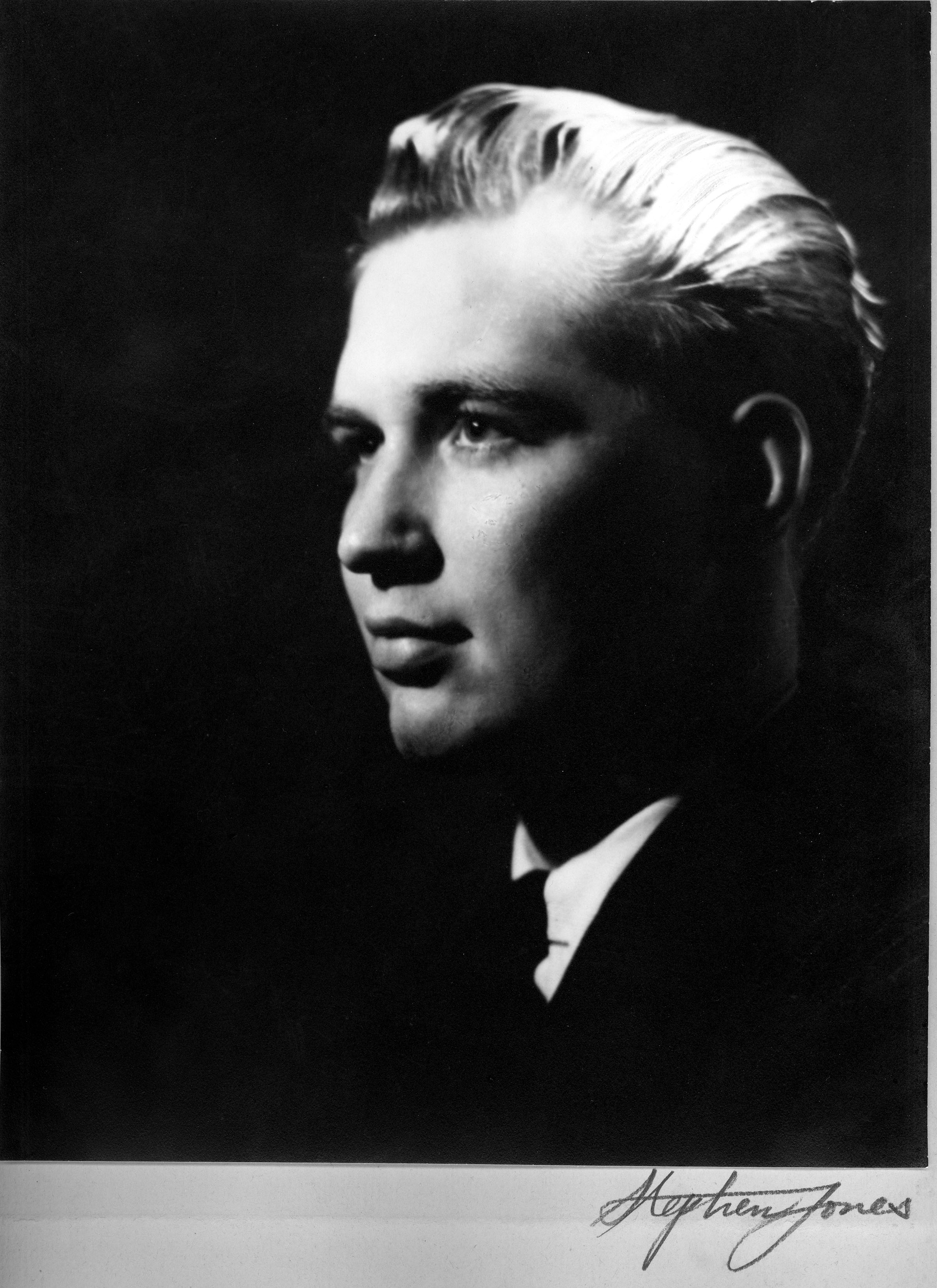
Charlie Voelker was a dedicated man with his heart set on helping and improving the community around him. In his career as an architect, Charlie always had a knack for personalizing homes to perfectly fit their intended residents. He would go far out of his way to make the homes as accommodating as he could. He did the same as a City of Waterloo alderman, going the extra mile with his ideas and constantly working to make Waterloo a beautiful place to live. He was incredibly gifted and extremely caring, often referred to as ahead of his time by his colleagues.
Architectural design
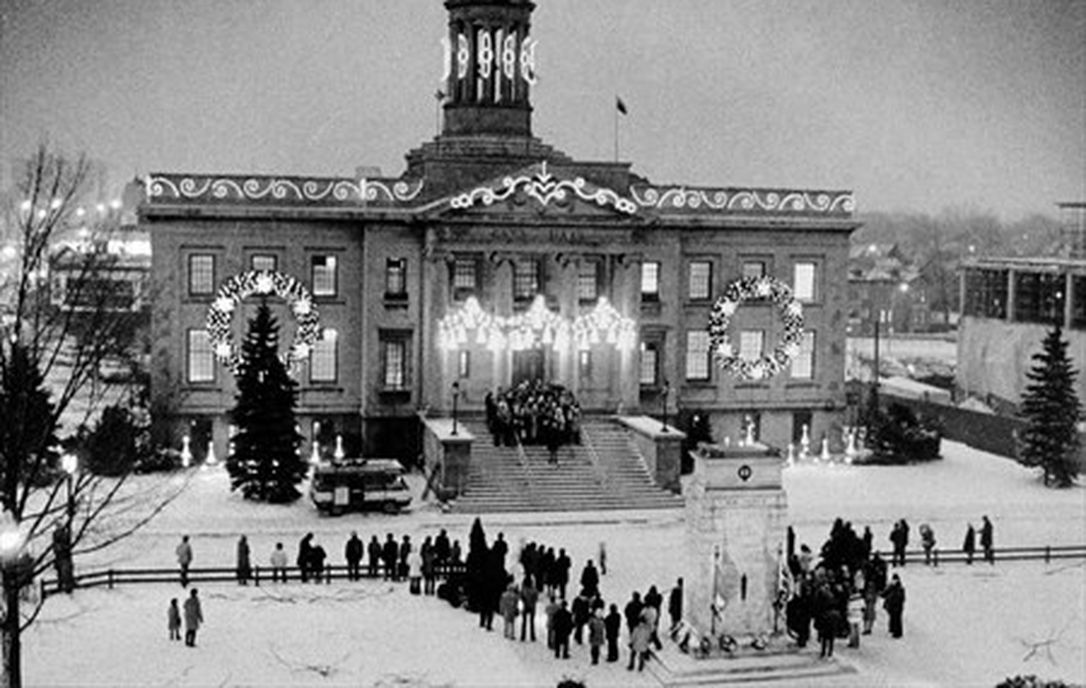
Charlie’s brand of architectural design reflected his love of colonial style architecture. He drew a lot of influence from his grandfather, Emil Vogelsang. Emil had been a German immigrant who established Berlin’s (now Kitchener) button industry in 1866. Charlie inherited Emil’s artistic talent and attention to detail and form. Another major influence for Charlie was William Schmalz, a local architect who designed Kitchener’s old city hall (1924-1973). William had lent Charlie a series of books on architecture and design which inspired and influenced his style. Voelker and Schmalz remained good friends over the years. Charlie would later design a home for him on Queen Street.

Early work
Charlie’s career began as a draftsman for Kitchener’s Galloway Furniture Limited in 1936, he was 17 at the time. This was his first design position, designing household furniture for the company. Charlie left Galloway in 1939, moving to Toronto to draw hydro-electric wire location maps. It was short-lived, as he returned to Kitchener in 1940 to work as a clerk for Goodrich Rubber Company. During World War II, Charlie studied munitions for three years before moving on to the Waterloo Manufacturing Company in 1944. It was here that his architectural design began to flourish. While working at Waterloo Manufacturing, Charlie designed homes for his friends and family on the side.

In 1947, Charlie designed and built a home for himself and his wife, Grace, at 29 Spring Street West (now a heritage landmark). It was also this year that he went independent, operating his architectural design firm out of his newly finished home. Working in the post-war period, it was very difficult for Charlie to get the materials necessary to accomplish his projects. Builders were granted government-issued priority numbers for their materials and had to offer their newly built homes to veterans before placing them on the open market. To get around the issue of materials, Charlie would travel to the dismantled army barracks at Camp Borden (near Peterborough) to buy lumber. He also scavenged the countryside for any little piece he could use to finish his projects.

Colonial structure
The main focus of Charlie’s work was colonial structure. He rejected the modernist movement of design, referring to it as a series of “boxes that lacked imagination”. He became so influential that he eventually sparked a revival of more gothic and colonial themes around the time of Canada’s Centennial.

This earned the nickname “Colonial Charlie” from his long time friend Larry Ertel, a home builder who he closely worked with for a number of years. One of Charlie’s most recognized accomplishments is Colonial Acres in North Waterloo, a beautiful subdivision and wonderful neighbourhood.

The idea for the development came from local developer William Oliver following a trip he and Charlie had taken to Rochester, New York in the early 1960s. They were so moved by the architecture they had seen that they decided to replicate it here in Waterloo. The overall design of the subdivision had no sidewalks, no gutters, and no curbs; it was Charlie’s ideal of cost efficiency and aesthetics.

Charlie designed 40 homes in Colonial Acres, demonstrating his love of colonial-style architecture. Although he designed many templates for houses within the subdivision, his passion was always designing custom houses to fit each homeowner.

Here is a home in Colonial Acres that Charlie and his son John worked, designed, and built together. Charlie very badly wanted to work with his son and design homes together. This was the only house they collaborated on. After a number of problems, Charlie and John never made a profit on their house.

Throughout his career, Charlie worked on a great number of private homes as well as businesses and commercial buildings. Charlie continued to design homes for friends and family, while still working for the Waterloo Manufacturing Company.

This perspective drawing was incredibly rare for Charlie to draw and does not appear in many other of his designs.

This house was designed by Charlie for Mr. and Mrs. Robert Arnold. Bob was a contractor who had worked closely with Charlie. It is the only plan in our collection that is hand-coloured.

Although Charlie did not design this home, he worked closely with local historians Dr. Kenneth and Elizabeth McLaughlin to conduct interior and exterior renovations on one of Waterloo’s oldest homes. Built in 1867 by then carpenter Conrad Fenner, it was originally a one-and-a-half storey Georgian house. It was enlarged to two storeys in 1886 as Fenner became an expert journeyman.

This project earned Charlie a great deal of recognition. Kenneth McLaughlin dedicated a portion of his 1990 book “Waterloo: An Illustrated History” to Charlie, recognizing his many contributions to the community and his efforts in preserving its past. Part of this building contains the original home of Abraham Erb, a Waterloo founder. Charlie renovated the building to create offices for the Hobson, Wood, Jenkins, Duncan, Wellhauser, and Taylor law firm. The building was designated a Waterloo heritage landmark by the LACAC in 1979.
City planning
“I like the small - time quality of Waterloo, where you can still walk down King Street and know the merchants by name. It just gives you a more small-town atmosphere. It’s too bad the city can’t stay like that. You can’t slow down growth.”
— Charles E. Voelker, Waterloo Chronicle, November 24, 1976

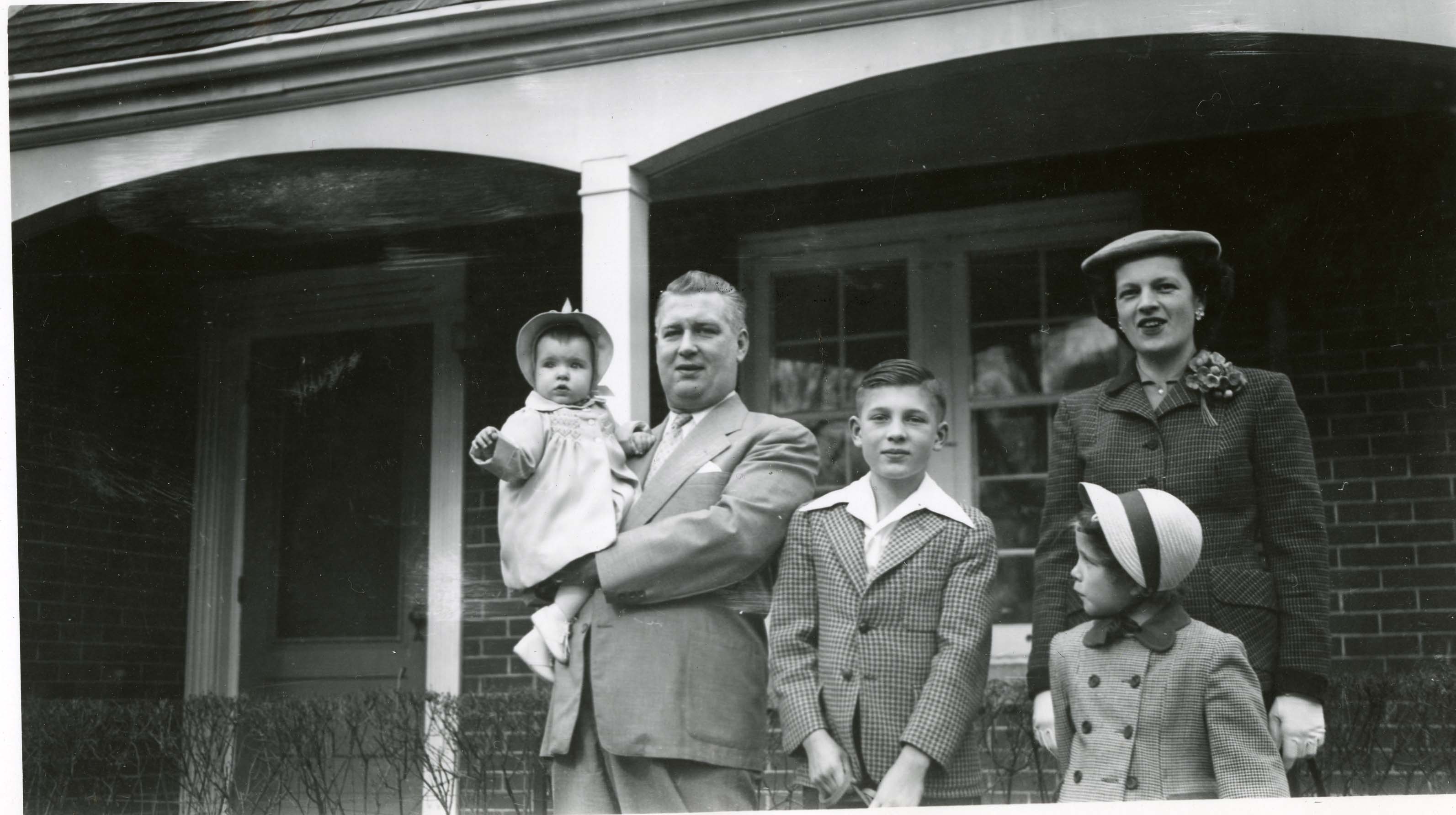
Charlie’s career was coming into prominence at a very important time for Waterloo. The post-war era created a need for city planners to be more innovative and take population growth into consideration. Materials were in short supply but housing was in a high demand. Meanwhile, the construction of the University of Waterloo and Wilfrid Laurier University meant that a larger temporary population of students would need places to stay while studying.

Between 1976 and 1986, the population in Waterloo increased by 12,095 with over 10,200 students living off-campus. This rapid growth led to what Charlie referred to as a bulldozing style of planning with the cost of housing going through the roof.

Charlie also had a hand in later designs at Waterloo Park. This refreshment booth, known as the Park Inn, was built at a cost of $5,000. The design also shows that Charlie would occasionally include figures in with his designs.

For more information on the park, check out our virtual exhibit on the history of Waterloo Park.
Alderman
“I’m probably a good councillor but a poor politician. I’ve never been a good speech maker, back slapper, or baby kisser but I’ve always got the job done.”
— Charles E. Voelker, Waterloo Chronicle, October 23, 1985

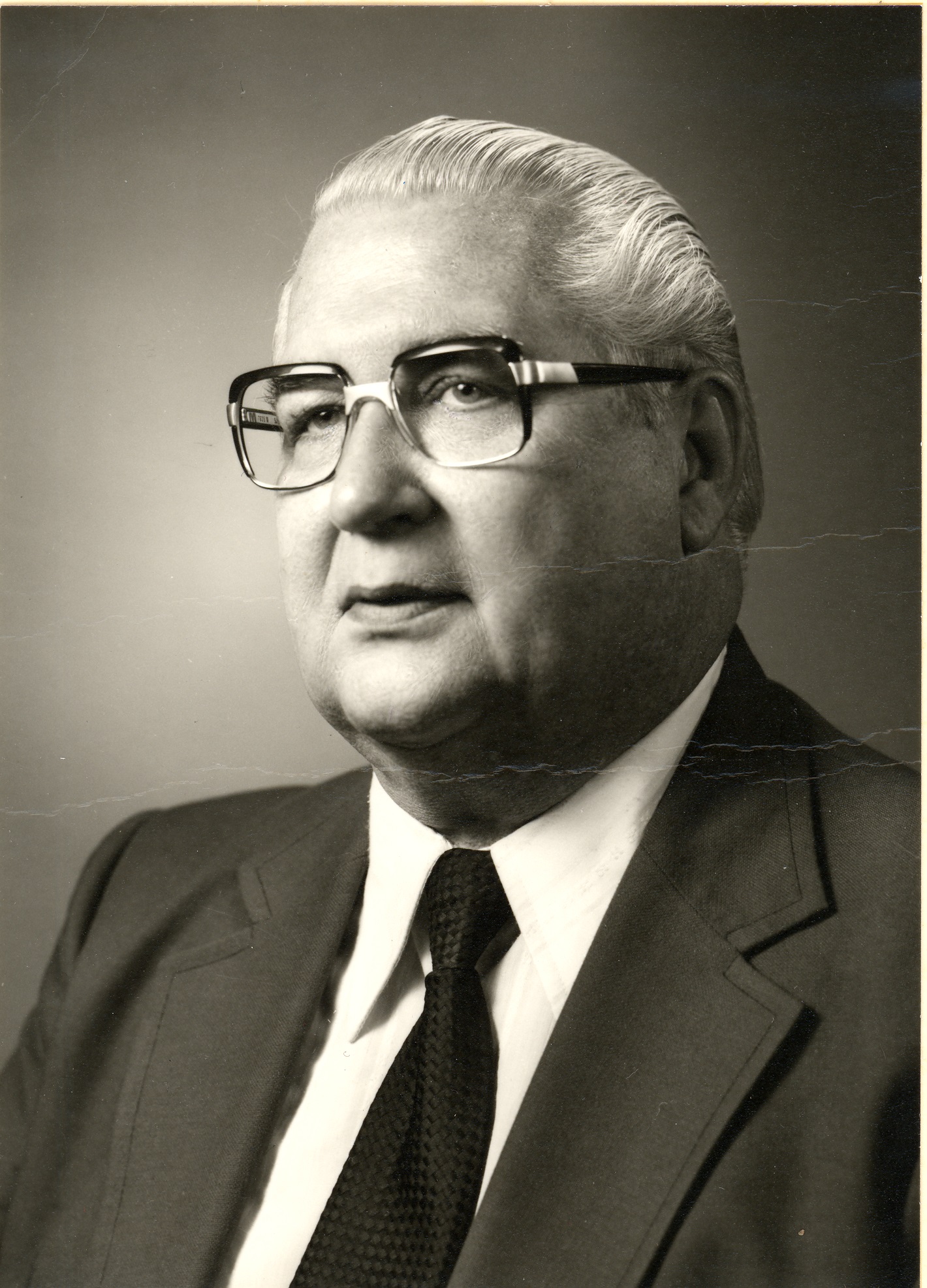
Charlie dedicated the equivalent of nearly 60 years of service to his community. In 1967, he was awarded the Canada Medal in recognition of his immense commitment to community service. He served 17 years on the Waterloo Public School Board as a Trustee and later as Chairman. He spent 20 years with the Waterloo Court of Revision before entering local politics in 1970. He spent 15 years as a Waterloo alderman; acted as a member of the Regional Land Purchasing Committee, and the Emergency Measures Committee; and was critical in founding the Local Architectural Conservation Advisory Committee (LACAC) in 1976.
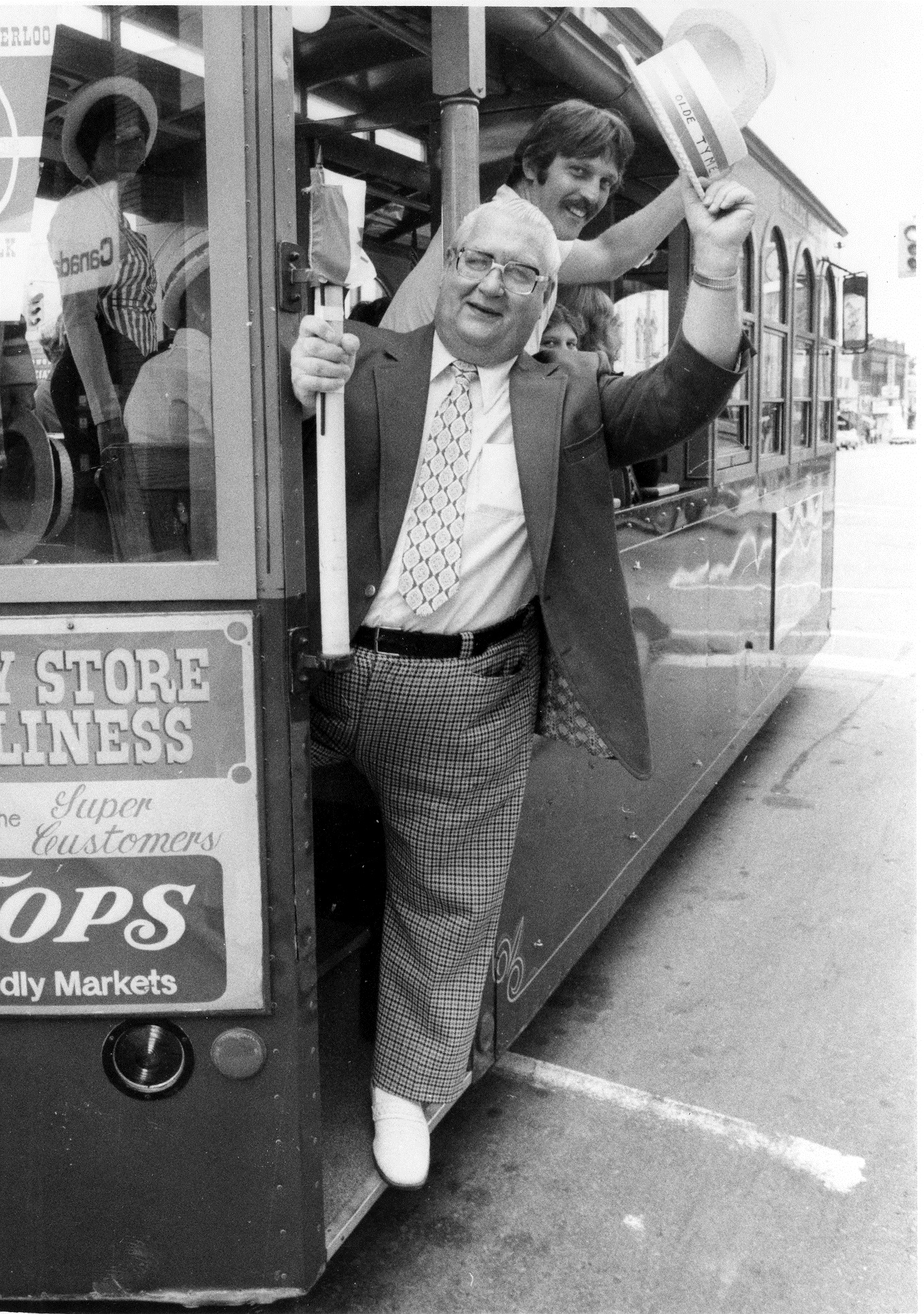
As an alderman, Charlie put forward countless ideas about innovative planning and improving the lives of Waterloo’s citizens. Admiring the colonial style of Rochester, New York, Charlie used it as an example of efficient city planning. He was very persuasive and managed to convince Council to allow him to improve the design of curbs, gutters, street lighting, and housing subdivisions. Charlie’s “Mystery Tours” were another means of getting his point across. What started off as family outings in which Charlie would test his children’s architectural knowledge, evolved into bus tours through New York State with city staff and Council.

He also used his time as an alderman to engage in widespread beautification projects around town. He initiated the Uptown Residents’ Association’s Civic Improvement Award for the residents or businesses that went the extra step in beautifying Waterloo. Upon his death, the award was renamed the “Charlie Voelker Award”, the first honouring Maple Lane Dairies (now Ethel’s Lounge) for planting numerous maple trees. Although Charlie made a number of incredible contributions while on Council, his efforts in establishing the region’s first crematorium have undoubtedly earned him the most recognition.

Although he did not design it himself, he spent six years and “seventy-five dollars worth of coffee to convince councillors” to construct the crematorium. The architectural firm of Snider Huget March designed the blueprints for the crematorium in 1976, finally opening in January of 1978. Charlie promoted it as a means of reducing the financial burden of funerals on families. Upon Charlie’s retirement from Waterloo Council in 1985, Mayor Marjorie Carroll presented him with a certificate for a ‘complementary cremation.’ When Charlie passed away the following year, the certificate was honoured and he was cremated at the very facility he had championed.
Visionary
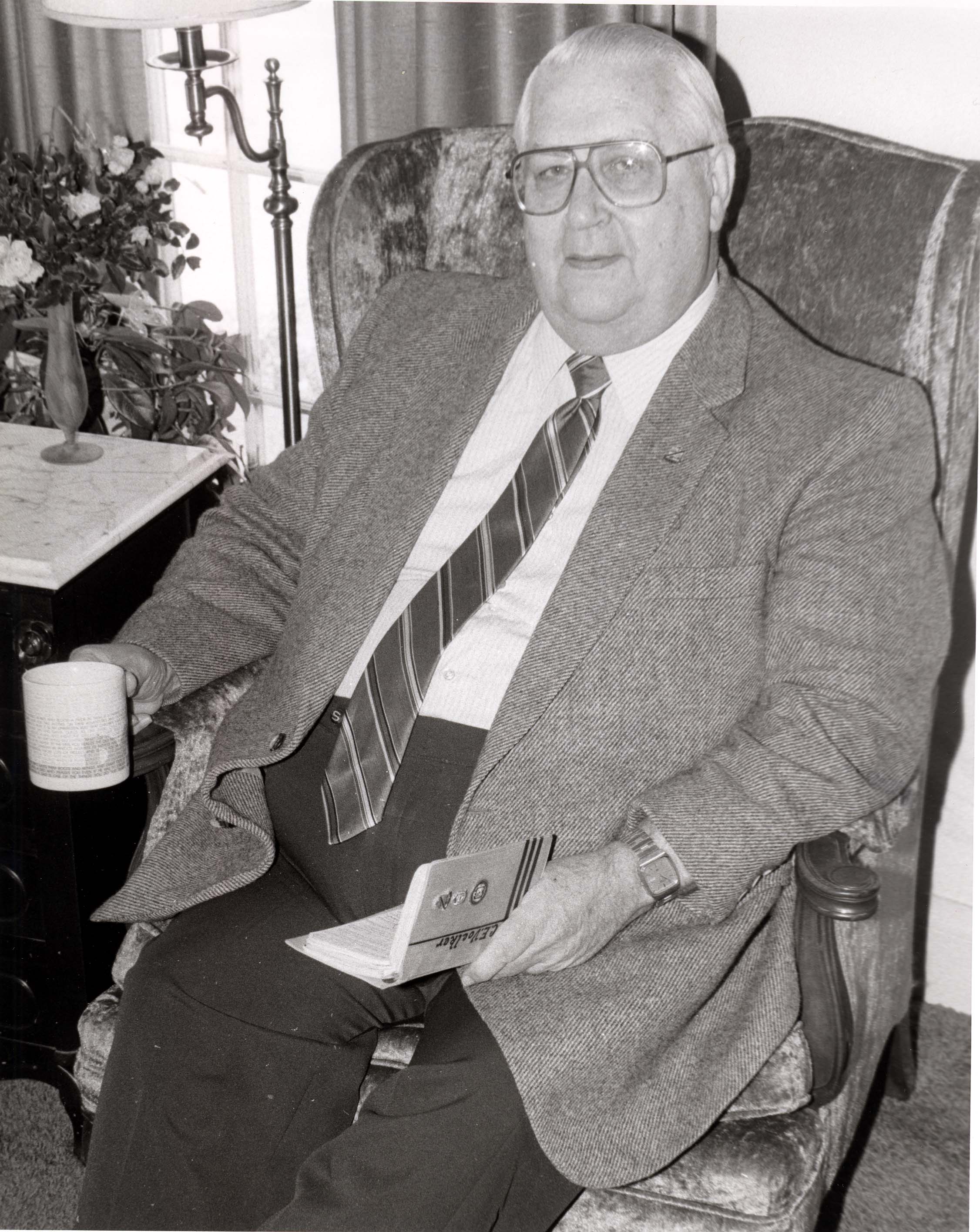
“I carry the [yellow] book around with me all the time, and if I see something, I just jot it down.”
— Charles E. Voelker, Waterloo Chronicle, December 16, 1981

Charlie used to carry around a small yellow book with him everywhere he went. He made notes about anything he thought could be improved upon or should be looked at for a future consideration. Charlie always felt his best time for inventing things was late at night, stretched out on the sofa and smoking his pipe.

A handful of his suggestions have become realities while others, as Charlie admitted, were considerably less practical. One of his proposals was for a new type of housing accommodation called a “granny flat,” a small home that could be built in a backyard. The concept was targeted at senior citizens and aimed to help manage housing for an aging population. Another of his ideas involved converting surplus schools into affordable housing for seniors. This process was planned to be reversible, making it possible to turn the spaces back into school rooms if needed. The conversion idea was endorsed by Council in 1978 but never implemented.
Other ideas included the beautification of uptown Waterloo, shelters from the rain in the parks, themed neighbourhood plazas, an expansion of the Waterloo Public Library, and seating for concerts in Waterloo Park. Many of his colleagues saw him as ahead of his time and a true visionary.
Charlie's legacy
Charles E. Voelker was an incredible member of the Waterloo community. His work as an architectural designer, an alderman, and a visionary has helped to etch his name into Waterloo’s history, leaving his mark through the beauty he left around town. When Charlie officially retired in 1985 at the age of 66, he was still in very high demand with projects on the go and a client list of 18 homes. Much of his architecture can still be seen around Waterloo, some homes and buildings have even received heritage landmark recognition from the LACAC. As an alderman he kept the community in mind and was constantly working to improve the lives of those around him. Seen as ahead of his time, his vision of a beautiful Waterloo was accomplished through his countless achievements and initiatives throughout Waterloo.