Virtual exhibit
Mayors of Waterloo
Part I: 1876-1900
Mayors of Waterloo Part 1: 1876-1900
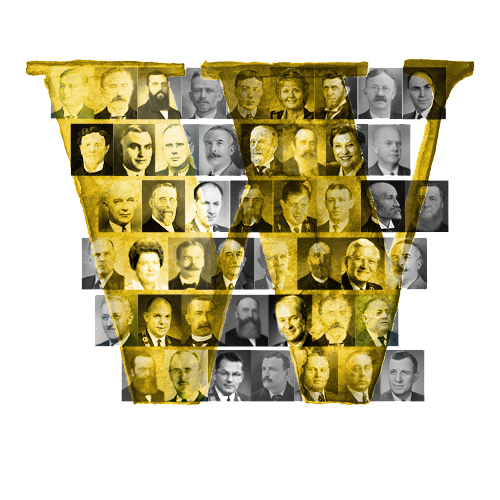
Since Waterloo became a town in 1876, over 50 people have served as mayor, guiding our growth and working for the betterment of the community. Follow along with this virtual exhibit to discover the lives of Waterloo's former Mayors and learn about some their contributions.

Moses Springer
Mayor of Waterloo: 1876-1877
Born in Doon in 1824, Springer became an orphan from a cholera epidemic in 1834 and was raised by Mennonite Bishop Joseph Hagey in Hespler (Cambridge).
When Waterloo became a town in February of 1876, Springer was elected the first Mayor. His term in office saw the establishment of many new laws and the passing of legislation for new businesses. As mayor, Springer negotiated an agreement in 1877 with the Grand Trunk Railway Company to run a line from Berlin to Waterloo.

Family
Springer was married three times. He and Barbara Shantz were married in February of 1845 in Waterloo by Reverend Jacob Huttner. Shantz was born on August 11 1825, in Waterloo.
They would have 12 children together. Shantz died in 1884 after years of failing health. Her obituary stated she "...was well known to the people of this county and highly esteemed by all who had the pleasure of her acquaintance." (The Galt Reporter)

Family
Springer next married Elizabeth Degenhardt in June of 1886. Degenhardt was born in Germany on July 21 1840. Their marriage did not last long as she died on a trip to Detroit in October of 1887.
Sophia Beasley and Springer married in April of 1890. Beasley was born in Ontario in 1850. She became a widow when Springer died in 1898.

Business/Community Involvement
When Springer moved to Waterloo from Berlin in 1854, he bought a German language newspaper called "Der Canadische Bauernfreund" which he ran until 1862. In 1856, he opened a grocery store on King Street in Waterloo.

Business/Community Involvement
Springer sat on the Waterloo Public School Board for 30 years. He was secretary and treasurer of the North Waterloo Agricultural Society. Active in the insurance business, in 1863 Springer was appointed first president of the Waterloo Mutual Fire Insurance Company. In 1868, he was a founder of the Mutual Life Assurance Company (Sun Life Financial).
Following his two terms as mayor, Springer became sheriff of Waterloo County, a position he held from 1881 until his death on Sept. 5, 1898.

George Randall
Mayor of Waterloo: 1878
Randall was born in New Hampshire on April 16 1832. He came to Canada in 1854 with his brother and uncle to build train stations.
Randall had served as the magistrate for the Village of Waterloo before becoming reeve of the new town in 1876. He completed two terms as reeve before he was elected mayor in 1878.
While in office, he ordered an official map of the new town, and he helped provide the town’s volunteer fire brigades with new uniforms. His interest in protecting the environment led him to address concerns over chemical dumping in Beaver Creek by local businesses.

Family
On April 10 1855, Randall married Caroline Roos in Preston (Cambridge), Ontario. They had four children together: Clara, Emma, George and Albert. Albert would die at 7 years old in 1878.

Family
Caroline Roos was born in Preston (Cambridge) on September 17th 1834. While not much is known about her, in 1898 she contributed recipes to The New Galt Cook Book. Her recipes were for sweet-bread soup, and escalloped fish.
George would pass away on December 23 1908, in Waterloo while Caroline passed in 1913 in Toronto. They are buried in Mount Hope Cemetery in Kitchener.

Business/Community Involvement
Randall was involved in many industries including the Granite Mills and Waterloo Distillery (Seagram’s). In 1884, he established a grocery and liquor warehouse with brother-in-law William Roos on Queen Street in Berlin (Kitchener).
Randall's involvement with the community included serving as a manager of the Berlin Quadrille Society in 1861, and as a director of the Waterloo Mutual Fire Insurance Company from 1875-1908, the last 18 years as president.
He was the first chairman of the Berlin-Waterloo Hospital Board in 1893, a charter member of the Waterloo Horticultural Society, and a member of the board of the Berlin high school.

Christian Kumpf
Mayor of Waterloo: 1879-1880; 1888-1889
Born in Germany on August 22 1838, Christian Kumpf immigrated to Canada in 1846.
During his first term as mayor between 1879-1880, Kumpf hosted the new Governor-General and his wife.
In 1888, during Kumpf’s second term, the town’s first municipal library was established. In 1889 Kumpf drove in the last spike during a ceremony to mark the extension of the Berlin Street Railway to Waterloo.

Family
On March 18th 1862, Kumpf married Bridget Caroline Cogan. She was born in Ireland in March of 1837. Immigrating to Canada in 1846, they married in Brant County. They would have 6 children together. Their last child, Alfred "Ford," was such a respected member of the Waterloo community that he was called "Mr. Waterloo."
In 1869 Kumpf purchased the old home of Abraham Erb at 172 King Street South to raise his family. Built in 1812, the house still stands today.
Christian would pass away on November 4 1905, while Bridget would pass on October 22 1919. They are buried in Mount Hope Cemetery, Kitchener.

Business/Community Involvement
When Kumpf came to Waterloo in 1861, he began working in Daniel Snyder’s store and post office, where he rose to the position of assistant postmaster. When Snyder retired in 1862, Kumpf became Waterloo’s postmaster. In 1860 Kumpf and John Bowman purchased the Berlin Chronicle and Provincial Reformer’s Gazette and moved it to Waterloo. They renamed it the Waterloo County Chronicle and sold the publication soon after.
Kumpf served on many community boards. In 1889 he established of the Dominion Life Assurance Company and became one of its two first vice-presidents. In 1890 he became the first president of the Waterloo Board of Trade, and chairman of the first Board of Park Management. Later he became a trustee on the first board of the Berlin-Waterloo Hospital built in 1894.

Benjamin Devitt
Mayor of Waterloo: 1881-1883
Benjamin Devitt was born the son of a grist mill operator in the Village of Bridgeport (Kitchener) on July 10 1835.
Active in local politics and village council, Devitt was elected mayor in 1881, five years after the incorporation of the Town of Waterloo.
One of the most debated issues during Devitt’s three-year term in office was the plan to buy a steam fire engine and construct a new fire hall. The project was not completed until he left office. In 1882, during Devitt’s second year as mayor, the Grand Trunk Railway completed a branch line to Waterloo.

Family
Benjamin Devitt and Nancy Lewis Bowman were married on September 29 1857, by Reverend William Smith in Kitchener. Nancy was born in Waterloo on January 1st 1839. They had eight children together: Ida, Emma, Anson, Alvah, Edward, Benjamin "Franklin," Daniel, and Hannah.
Benjamin would pass away on September 4, 1910, and Nancy would follow on May 28, 1921. The couple are buried in Mount Hope Cemetery, Kitchener.

Business/Community Involvement
Devitt received his early education in the log schoolhouse currently located in Waterloo Park.

Business/Community Involvement
In 1860 Devitt would construct what became known as the Devitt-Snyder Block on King Street in partnership with local postmaster Daniel Snyder. From this location, Devitt operated a general store. He was also employed as the hotel building inspector for Waterloo for several years.
Devitt was critical in the formation of the Waterloo Musical Society and became the founding president in 1882. He served on the board of the Mechanics Institute and when it became a municipal library, Devitt continued serving on the board.

George Moore
Mayor of Waterloo: 1884; 1890
George Moore was born in Preston (Cambridge) on July 26 1845. Married in 1875, Moore moved to Waterloo where he worked in the hops business.
After serving in town council, he became mayor for a one-year term in 1884. The major accomplishment during this term in office was the buying of a steam engine for the town’s fire brigade. Moore returned to council, and in 1889, was re-elected mayor.
In Moore’s 1890 term, he supported the establishment of the Waterloo Board of Trade. He also oversaw the purchase of the 65-acre Jacob Eby farm for the creation of a municipal park (now Waterloo Park).

Family
On January 20 1875, Moore married Mary Barrie. She was born in September of 1850 in North Dumfries Township. George and Mary would have five children: Isabel "Bella", Elizabeth, Agnes "Georgina", George, and Robert.
Mary would die young, passing away at the age of 38 from blood poisoning in January 1888 leaving George to raise the children. He never remarried. George would pass on October 23 1916. They are buried in Mount Hope Cemetery, Kitchener.

Business/Community Involvement
Moore was involved in many businesses in the area. The list includes the Berlin Robe and Clothing Company, the Waterloo Woollen Manufacturing Company, the Waterloo Brick Yards, and the Waterloo Gas Company.
He was also a large landowner in Waterloo, ranking seventh in 1878 and eighth in 1897 in value of property.
As a charter member of the Waterloo Board of Trade, he served as president in 1905. Noted as an avid horseman, he bred show horses winning first prize at the 1893 Chicago World’s Fair.

William Snider
Mayor of Waterloo: 1885-1886; 1891-1892
William Snider was born October 26th 1845. As a young man he entered his father's mill in Waterloo as an apprentice.
Snider first served on the village council beginning in 1873. He was later an alderman as well as town reeve.
During his two terms in office, Snider helped establish a weekly market in the basement of the Town Hall. He created the formal Town Fire Company and secured the installation of gas lighting. Under his guidance, council approved a proposal by the town’s first Mayor, Moses Springer, to commission portraits of former mayors for display in the council chambers.

Family
On June 11 1867, Snider married Lydia Ann Bowman. She was born on April 20, 1846, in Bloomingdale, Woolwich Township. They would have five children together: Susannah, Minnie "Albert", Elma, Clara, and Frederick. Lydia Bowman would pass away on the 16 July 1900, at 54 years old.
Snider later married Martha Faith Gribble in 1902. She was born in Devon, England, on October 31 1874, and immigrated to Canada in 1895. She is listed as a nurse pupil in the 1901 census. They had two children together. After William's death on March 6 1915, Martha moved to Santa Monica, California, and remarried in 1919.
The photograph is the Snider family home, located at 59 Albert Street. It was torn down in the 1970s.

Business/Community Involvement
Like other mayors, William Snider’s business involvements suggests his large influence within the community. He was president of the Waterloo Mutual Fire Insurance Company, director for 10 years of the Mutual Life Assurance Company (Sun Life Financial), and vice-president of Waterloo Manufacturing Company. He was a founding member of the Waterloo Board of Trade, a member of the Waterloo Horticultural Society and served on the Waterloo Board of Park Management from 1890-1906.

Jacob Conrad
Mayor of Waterloo: 1887
Born in Prussia (Germany) on September 5 1836, Jacob Conrad came to Waterloo from New York around 1855.
Conrad was on Waterloo Council for many years before becoming mayor in 1887. Although he served for only a one-year term, he helped redefine the town lines between Berlin (Kitchener) and Waterloo. He also saw the benefits of establishing a free library, and council that year passed a by-law creating one.

Family
On April 8 1858, Jacob Conrad married Wilhelmina Dorothea Louisa Kriesel in Waterloo Township. Like Jacob, Wilhelmina was born in Germany on January 28 1836, and immigrated to Canada in 1857. They would have 13 children: Wilhelm, Caroline, Wilhelmine, Catherina, Jacob George, Elizabeth, Ida, Jacob, Charles, Martha, William, Ottilia, and Alma. Wilhelmina would pass away on May 15 1908, followed by Jacob on January 25 1911. They are buried in Mount Hope Cemetery, Kitchener.

Business/Community Involvement
Jacob Conrad worked in the tinsmithing business of Henry "Sandy" Robelson before starting his own hardware and tinsmithing store in 1858. He later constructed a two-storey building on King Street known as the Conrad Block. He continued in the tinsmithing business until he retired in 1899, at which time his sons took over the operation.

Business/Community Involvement
Passionate about music, Conrad was a member of the Harmonie Singing Society and was active in local saengerfests (singing festivals). In 1889 he was one of the founding directors of the Dominion Life Assurance Company, and the following year served on the first Board of Park Management. Conrad was also a member of the Germania Lodge and the Grand River Masonic Lodge.

Walter Wells
Mayor of Waterloo: 1893
Born on September 18 1833, in King Township, north of Toronto, Walter Wells spent his early years on the family farm. At the age of 19, he moved to Galt (Cambridge) where he learned the iron and steel working trade.
Between 1876 and 1889, Wells held periodic positions on town council.
During Wells' term as mayor, Joseph E. Seagram donated land for the construction of a joint Berlin-Waterloo Hospital. Wells gave authority to electrify the street railway, and the Town Council introduced annual fees for stalls at the Waterloo Market.

Family
Walter Wells married Isabella Tyson on October 28 1856. She was born on July 24 1838 in Waterloo Township. They had eight children together. Isabella died from blood poisoning in 1881, three days after giving birth to their child Walter Bell Wells.
Wells next married Rosina Roos on September 5 1887 in Berlin (Kitchener). She was born on March 24 1858 in Preston (Cambridge). They had two children together. Walter would pass away on March 10 1912, while Rosina would pass on February 18 1936. Isabella, Walter, and Rosina are buried in Mount Hope Cemetery, Kitchener.

Business/Community Involvement
After working in Galt, Walter Wells left for New York where he lived for several years. Returning to Waterloo, he started a wagon-making shop on Caroline Street in partnership with Isaac Weaver.
In 1866, Wells attended the Royal College of Dental Surgeons. In 1868, he set up his dental practice above Simon Snyder’s Drug Store on King Street. Wells spent 44 years as a dental professional before retiring in 1910.
Wells' interests included the Masonic Order and the Ancient Order of Workmen. He was critical in the establishment of Westside Park (now Waterloo Park) in 1890 and sat on the first Board of Park Management.

Robert Fish
Mayor of Waterloo: 1894
Born in Trafalgar Township, Halton, on July 9 1835, Robert Fish lived in Linwood before moving to Waterloo in the late 1880s.
His one year in office saw council address public safety at railway crossings and fire safety with the installation of fire hydrants.
As mayor, Fish sat on the first advisory council of the Waterloo Board of Trade. In 1902 he returned to Linwood where he operated the Linwood Corner Store.

Family
On December 17 1864, Robert Fish married Mary Jane Reynolds. She was born on July 9 1839, in Duffin's Creek, Pickering Township. They had three children with Mary dying in 1867 after giving birth to their son John Albert Fish. She is buried in Mount Hope Cemetery, Kitchener.
Fish next married Sarah Amelia Dyson on November 17 1875. She was born in Churchville, Peel County on September 27 1841. They had one child together who died at an early age. Sarah passed away on March 16 1914, while Robert passed on April 12 1928. They are buried in Mount Hope Cemetery, Kitchener.

Business/Community Involvement
While living in Linwood, Robert Fish became a pump-maker and sawyer. He later left the pump-making business to start up a general store in the 1860s.
Fish had a lumber business with sawmills at Elmsdale, Perry Township and Parry Sound. From 1868-1887, Fish became the Linwood postmaster, operating the post office from his store. In the 1880s he left for New York, but returned to settle in Waterloo where he operated a dry goods store in part of the Central Block.
Fish, like other mayors, sought to better the community. In August 1890, while chair of the Waterloo Parks Committee, he proposed Jacob Eby's farm be purchased and turned into a public park. In September a vote passed and the land was acquired.

Simon Snyder
Mayor of Waterloo: 1895-1897
Simon Snyder was born in Bloomingdale Township on March 31 1846.
During his term as mayor, several water reservoirs were constructed for firefighting purposes. A plan was developed to buy the Waterloo Waterworks and install a new comprehensive water plant.
Public health issues were addressed by council under Snyder. By-laws governing milk-testing and the inspection of slaughtered beef were passed. Snyder served one more year on council as an alderman in 1899, the year the Waterloo Water Commission was established to build the new municipal waterworks system.

Family
On April 30 1872, Snyder married Elizabeth Schnarr in Preston (Cambridge). She was born on March 29 1852. They had ten children together. Elizabeth died at 38 years of age in March of 1890. She is buried in Mount Hope Cemetery, Kitchener.

Family
Snyder next married Matilda Roos on the March 28 1895. She was born on April 16 1853, while her parents were sailing to Canada from Germany. They had no children together. They are buried in Mount Hope Cemetery, Kitchener.

Business/Community Involvement
In 1864 Snyder worked as a clerk in his brother-in-law’s store in the Village of Conestoga. The following year, he attended Day’s Commercial College in Toronto. Upon graduation, he briefly clerked with the Waterloo Mutual Fire Insurance Company.
Around 1889, Snyder and Henry Roos purchased the furniture manufacturer of Reichert and Company, creating Snyder, Roos and Company. The partners also acquired the Schaefer-Killer Furniture Company in Waterloo. In 1900, they combined the two companies to become Canada Furniture Manufacturers Limited. Snyder became the company’s first president in 1902.
His musical interests are evident as he became the first treasurer of the Waterloo Musical Society in 1882. As well he was a founding director of the Dominion Life Assurance Company in 1889.

Jeremiah Hughes
Mayor of Waterloo: 1898
Born on September 28 1836, near Heidelberg, Ontario, Jeremiah Hughes grew up on a farm and later worked in a blacksmith shop.
Hughes served only one term on the town council before he was elected mayor. In 1898, council created a new town engineer position and passed a bylaw for conducting a town census.
That year a new "western reversible road machine" was purchased. This made road construction and maintenance easier. A bicycle path for Bridgeport Road was also approved.

Family
On March 7 1859, Hughes married Laura Winn in Kitchener. She was born on March 2 1835. they would have five children together: Edgar, Eleanor, Theophilus, Frederick, and Laura.

Family
Jeremiah passed away on August 27 1920, leaving Laura a widow. Six years later, on July 19, Laura would pass away. They are buried in Mount Hope Cemetery, Kitchener.

Business/Community Involvement
Jeremiah Hughes was part of a group of local businessmen who generated the idea of mutual insurance and established Waterloo's first insurance company in 1863. Waterloo Mutual Fire Insurance Company was the result. Hughes worked as the company’s inspector and later became an independent insurance agent.
In 1889 Hughes was one of the founding directors of another insurance business, the Dominion Life Assurance Company.
His community work included serving as chair of a committee to oversee the construction of the Berlin-Waterloo Hospital that opened in 1895.

George Diebel
Mayor of Waterloo: 1899-1900
George Diebel was born on February 3rd 1850, in Lisbon, Wellesley Township. Early in his life, he worked in a general store in New Dundee. He came to Waterloo in the early 1880s.
When Diebel became mayor, he helped Waterloo established its own Water Commission in 1899. This was done to supply the town with water as previously it was provided by Berlin (Kitchener).
In 1899 council petitioned the Governor-General, "praying for the erection of suitable public buildings in the Town of Waterloo." Council also struck an agreement with Berlin to buy land for extending Moore Avenue and Waterloo Street. The following year council aided the Goderich Railway Company by approving the extension of rail lines through the town.

Family
After moving to Waterloo, Diebel married Nancie Strome on September 9 1874. She was born on October 3 1849, in Waterloo Township. They would have two daughters together, both of whom would pass away before their parents. A grandchild, Ruth, survived into adulthood and cared for Nancie after George's death.
George tragically took his own life on November 15 1922, while Nancie passed away on April 25 1936. The couple is buried in Mount Hope Cemetery, Kitchener.

Business/Community Involvement
In 1876, Diebel became a partner with Cyrus Bricker and in 1886 they opened the Great Corner Store in unit no. 1 of the Commercial Block at King and Erb Streets. In 1905, upon the death of Christian Kumpf, Diebel became Waterloo's postmaster.

Business/Community Involvement
Diebel was elected vice-president of the Waterloo Mutual Fire Insurance Company in 1908. He became president after the death of William Snider in 1915, and held this position until his death in 1922.
Diebel was a big supporter of the Berlin-Waterloo Hospital, giving money and serving as member of the hospital board since its beginning in 1896.