
Build or change a fence

Most fences don’t need a permit, but you must follow the Fence Bylaw. If you’re building a fence around a pool or hot tub, get an enclosure permit first.

Follow these steps to make sure your fence meets the rules.


On this page

  1. Check the fence height limits
  2. Make sure you're not blocking sightlines
  3. Avoid these fence types
  4. Talk to your neighbour
  5. Apply for a variance
  6. Report a fence problem
  7. Contact us

1. Check the fence height limits for your property

Corner lot:

  • front yard – up to 0.9 m (3 ft)
  • flankage yard – up to 1.83 m (6 ft)
  • rear and interior side yards – up to 2.44 m (8 ft)

Interior lot:

  • front yard – up to 0.9 m (3 ft)
  • rear and interior side yards – up to 2.44 m (8 ft)

Special allowances apply for gates, archways, sports courts and properties with different grades.


2. Make sure you’re not blocking sightlines

Fences must not block the view for drivers or people walking. 

  • Daylight Visibility Triangle (DLVT) – a safety zone at the corner where two streets meet. No fence is allowed in this area
  • Driveway Visibility Triangle (DVT) – a safety zone where a driveway meets the street. Fences in this area can't be higher than 0.9 m (3 ft), whether the driveway is on your property or your neighbour’s.

Follow these steps to measure your DLVT:

  1. Start where your front lot line meets your side (flankage) lot line.
  2. Measure 3 m (10 ft) along the front lot line and mark the spot.
  3. Measure 15 m (50 ft) along the side (flankage) lot line and mark the spot.
  4. Draw a straight line between the two marks.
  5. The triangle between this line and the corner of your lot is the DLVT — no fence is allowed inside it.
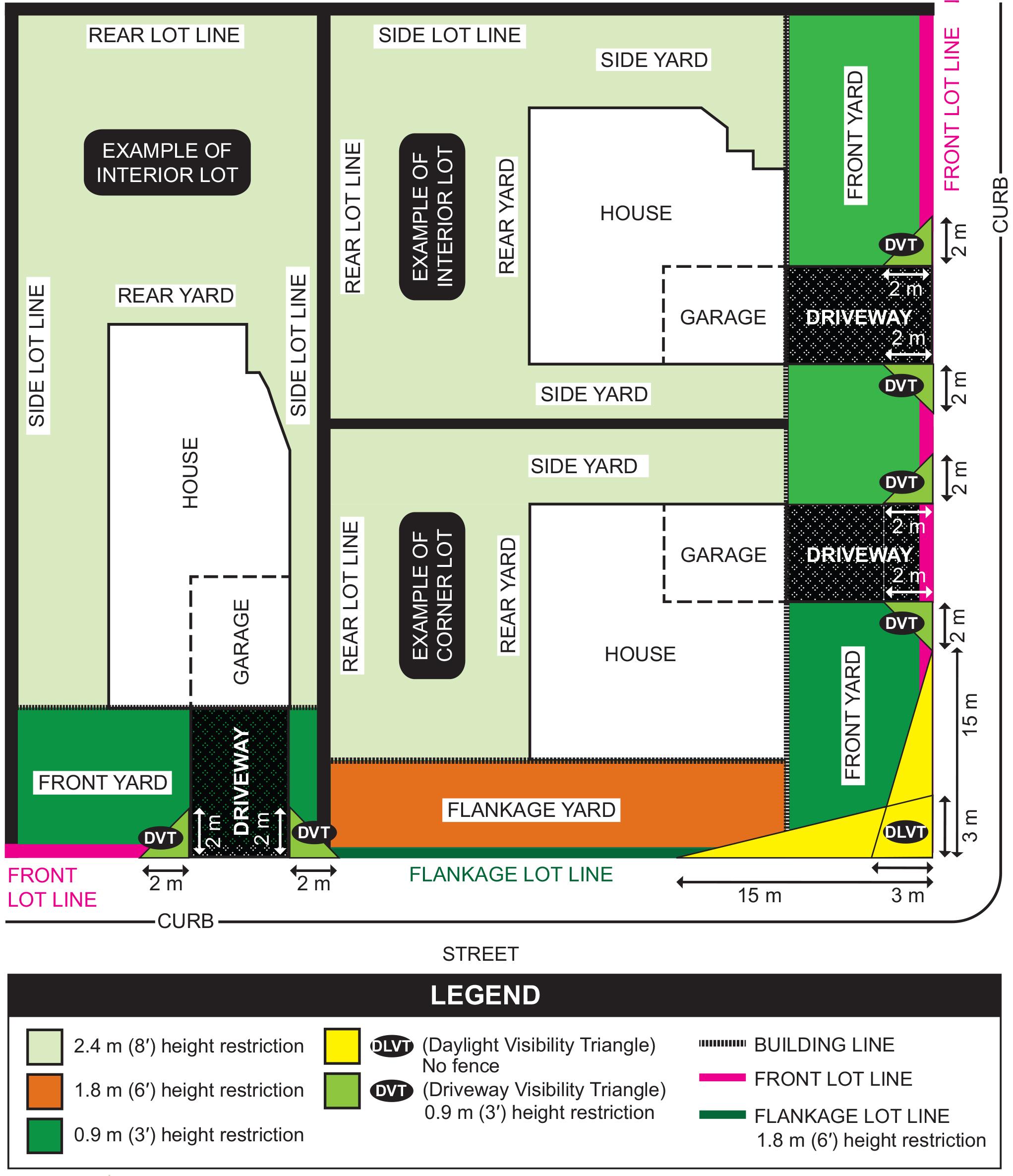
Follow these steps to measure your DVT:

  1. Start at the point where your driveway meets the front lot line.
  2. Measure 2 m (6.56 ft) along the front lot line and mark the spot.
  3. Measure 2 m (6.56 ft) diagonally from that mark toward your driveway and mark the spot.
  4. The triangle formed here is your DVT — no fence over 0.9 m (3 ft) is allowed inside it.

DLVT and DVT map

Avoid these common violations of the fence bylaw:

  • building in the daylight visibility triangle
  • fences that block the view for drivers or pedestrians
  • encroachment – putting a fence on city property

3. Avoid prohibited fence types

You cannot build:

  • barbed wire or electric fences in residential areas
  • brick, stone, cement or masonry fences over 0.6 m (2 ft) without a building permit
  • fences on city property (encroachment) without written permission
  • fences with mismatched or unsightly sections
  • fences with the structural side facing your neighbour unless they agree (chain link excluded)

4. Talk to your neighbour

If the fence is on the property line, the Division Fence Bylaw explains how to share costs and responsibilities.


5. If your fence doesn’t meet the rules, apply for a variance

You can ask the Fence Variance Committee for an exception. 

Apply for a fence variance


Report a fence problem

To report a fence that doesn’t follow the rules, make a fence complaint.


Contact us

Contact the Municipal Enforcement team to ask a question or report a problem: