
How grading and drainage work
Grading and drainage work together to move water away from your home and into the city’s stormwater system.
Learn how to maintain drainage on your property.
On this page:
How grading works
Grading is the slope or shape of the ground on your property. It helps direct water away from your home and toward safe places to drain.
Good grading helps:
- move water away from your home and other buildings
- direct runoff to a safe outlet, such as a catch basin or swale
- prevent pooling, damp basements and drainage issues with neighbours
Over time, soil can settle and change how water flows. Check your yard after heavy rain. You may need to fill in low spots or adjust the slope.
Subdivision grading
Subdivision grading plans are designed by engineers and approved by the city to make sure water drains safely across neighbourhoods.
- the builder or developer maintains grading for 2 years after city approval
- homeowners shouldn’t alter grading during this period
- after 2 years, the homeowner is responsible for keeping their property graded correctly
How water moves across your property
Every yard drains differently depending on how it was built and graded.
Back-to-front drainage
- the highest point is near the back of your lot
- water flows through side-yard swales and out to the street at the front
Split drainage
- the highest point is beside your house
- some water flows toward the street
- the rest flows to the back, where it’s collected in a swale or catch basin before draining into a storm
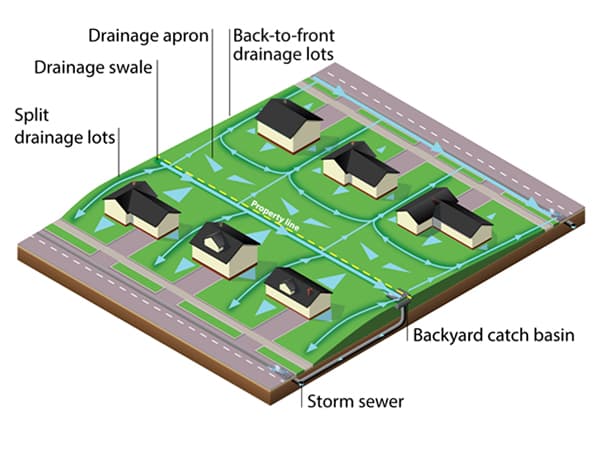
Property grading example. Image source: City of Guelph

Window well
- a curved metal or concrete wall around basement windows
- keeps soil back and lets water drain away from the foundation
- check for leaks and make sure the well is sealed

Rear-yard drain or catch basin
- a grated drain that collects water and moves it underground
- found at low points between homes
- keep the grate free of leaves and debris

Positive slope
- the rise of soil away from your house that directs water away from your foundation
- can flatten as soil settles — build it back up if needed

Drainage swale
- a shallow, grassy channel that carries rain and melting snow away from your home
- usually runs along property lines or at the back of a lot
- keep it clear – don’t fill it in or block it

Infiltration trench or gallery
- an underground gravel-filled pit that helps rain soak into the ground
- usually found at the back of newer lots
- keep the area above it clear of heavy items, soil build-up or paving